Forum Activity for @folkfan

folkfan
@folkfan
04/17/10 02:13:40PM
357 posts

purpose of design features on a MD


Instruments- discuss specific features, luthiers, instrument problems & questions

D.T. Remember when it comes to comparing the sounds of wood from a guitar to a dulcimer, there is a great deal more wood sounding on a guitar and the bracing is different as well. Your combination of woods can have both a bright and a mellow tone depending on the size of the instrument and where the bridge is place in relationship to the tail block. A longer VSL can have a tinny sound in the higher octaves if the construction of the instrument narrows the body out under those frets and you have a small strum hollow way out on the end of the instrument. Or you can have a shorter VSL that doesn't sound tinny as the body of the instrument is wide and deep well beyond the end of the VSL. But if the luthier has correctly placed the frets you shouldn't have a drastic sharping or flatting of notes in the higher octave. Even the same VSL can sound different based on the shape of the instrument. Is that clear, or have I just confused you????.
Paul Certo
@paul-certo
04/17/10 10:47:36AM
242 posts

purpose of design features on a MD


Instruments- discuss specific features, luthiers, instrument problems & questions

Cedar starts out mellower than spruce, but spruce mellows more as it ages. I believe spruce is considered to have a greater capacity to mellow as it ages than cedar does. I also have a cedar topped 12 string, and love the sound of it. There will be other factors that affect the sound as well. One of my dulcimers sounds a lot better played more gently, the other I can play as hard as I want and it still sounds good. There are several variables, and I really have no idea which variable is responsible to what extent. If you are able to get to a festival and play several dulcimers, you may find an instrument you can't walk away from. Maybe a road trip is in order?Paul
Dusty Turtle
@dusty
04/16/10 11:12:48PM
1,856 posts

purpose of design features on a MD


Instruments- discuss specific features, luthiers, instrument problems & questions

Thanks, Folkfan. I don't think my fingers could hand a 30" VSL either. My current dulcimer has a VSL of 27" and there are some times when chording is a bit of a stretch. But on the other hand, when I move really high up the fretboard the instrument just sounds tinny. That might simply be due to mediocre craftsmanship, but I wonder if a longer VSL would help the strings ring out better when I finger them way up high like that.I'm undecided about the double back and scalloped fretboard. The idea of more volume is enticing, but there is something about the very simply design of dulcimers without those features that I find alluring. A simple folk instrument should be comfortable in a pair of blue jeans, not decked out in a tux.Thanks for your thoughts. Perhaps in a few months when I do get my new dulcimer I'll post an update so you can all know where I ended up.Thanks.D.T. folkfan said:
A double back will increase volume and might with the way you play increase it even more as both backs aren't as muffled as the bottom back is when lying across the lap.

Many makers allow the top to move more freely by decreasing the fretboard internally. They rout it out. Others will scallop. I like the full length fretboard for the bracing of the top along the complete length of the fretboard. Personal preference.

I've never had a dulcimer with a binding so I can't tell you anything about them.

Personally I like a semi gloss finish in a lacquer. The really heavy glossy coating on an instrument as small bodied as a normal dulcimer would deaden the sound, (IMO)

For my hand size I prefer a VSL just under 26inches, I had one once with a 30 inch and never could play it. I tried to learn chording on a longer VSL, but had an increased problem with my hands due to the stretch and strain, so gave up chording entirely.

I'd say go with the 1+ and 8+ if you think you'll use them.
Dusty Turtle
@dusty
04/16/10 11:00:18PM
1,856 posts

purpose of design features on a MD


Instruments- discuss specific features, luthiers, instrument problems & questions

Thanks, Paul, for taking so much time to respond to my post. I don't really have the ability to play a lot of instruments, which is a big part of my dilemma. The music stores in town don't carry dulcimers, and the one "festival" in the neighborhood (Redwood Dulcimer Day, about a 3-hour drive) isn't big enough to attract vendors. Except for the one day of that festival last summer, I've never heard a dulcimer played live other than my own. My 12-string guitar, which has a cedar top, has a more mellow sound than most guitars with a spruce top, so I think I know what people mean when they say one wood has a "brighter" tone than another, but honestly I'm not really sure. I wish I had the opportunity to play a dozen or more different dulcimers just to compare sounds, but I don't have that luxury.Anyway, thanks again for the information. You did clear up a number of questions I had.D.T. Paul Certo said:
The double back allows the back to vibrate more freely and allows a bit more volume. The scallopped fretboard would help in the same way by letting the top vibrate more. The scallops also allow you to use a guitar capo, if they are located under the area where you would capo each fret. So the scallops would have the same spacing pattern as the frets, at least up to the 7th fret. I'm not sure if anyone would capo above that point, but it's an option. There are a few other things builders do to increase volume, such as only allowing part of the fretboard to contact the top. Usually, the area towards the tuners is anchored to the top, and the other end of the fretboard is cut away to let the top vibrate free.
The zero fret is just in front of the nut. It allows the strings to be as close to the neck at the 1st fret as it would be to other frets when you press the string down to the frets. A skilled maker can adjust the nut height so the zero fret is unnecessary, but some makers use them. I have one guitar & one dulcimer with zero frets, and others without. I wouldn't order one on purpose, if your chosen maker doesn't normally use one. It does nothing to justify the expense, unless the maker doesn't want to take the time to adjust the string height at the nut. If a builder told me he wasn't willing to make his instruments play well, I'd find another maker. On the other hand, my dulcimers were both kits. The maker of a kit has no control over the abilities, or lack of abillities, his kit will recieve. I can completely understand the use of a zero fret in a kit. It's much simpler for a hack like me to get good action without ruining 2 or 3 nuts on the way. It also makes it possible to build a kit with less nut slotting tools. Again, the home hobbyist/builder is in mind here.
Binding is mostly decorative. It does seal the end grain of the wood, but I'm not sure how much need there is for it. Mine don't have it, I suspect most kit models don't.
A thick heavy finish will deaden the sound of an instrument. But a proper, thin finish can shine, it depends on the product used.
A short VSL will bring the frets closer together. If you have small hands, this makes it easier to play, if you use chords, or find yourself stretching to get your thumb on a fret far above your fingers. Playing noter style you might never see a problem either way. With a longer vsl, you have to tighten the strings to a higher tension to reach the same pitches. This extra tension makes the strings a bit harder to press to the frets, but with the action adjusted correctly, this shouldn't be a problem/ That goes back to the nut adjustment in the 1st question, plus the bridge height.
Softer woods such as spruce and cedar are pretty much the standard for most string instrument tops, with hard woods the standard for back & sides. The best thing to do is play as many dulcimers as you can to hear how the different choices affect the sound. Maple is a brighter sounding wood than walnut, mahogany or rosewood. It really comes down to what you want your new toy to sound like. Try as many as you can, and see what you like in woods, sounds and VSL's. Take your time, there's lots of choices. You wouldn't want to miss any!
Paul
folkfan
@folkfan
04/16/10 09:24:35PM
357 posts

purpose of design features on a MD


Instruments- discuss specific features, luthiers, instrument problems & questions

A double back will increase volume and might with the way you play increase it even more as both backs aren't as muffled as the bottom back is when lying across the lap.Many makers allow the top to move more freely by decreasing the fretboard internally. They rout it out. Others will scallop. I like the full length fretboard for the bracing of the top along the complete length of the fretboard. Personal preference.I've never had a dulcimer with a binding so I can't tell you anything about them.Personally I like a semi gloss finish in a lacquer. The really heavy glossy coating on an instrument as small bodied as a normal dulcimer would deaden the sound, (IMO)For my hand size I prefer a VSL just under 26inches, I had one once with a 30 inch and never could play it. I tried to learn chording on a longer VSL, but had an increased problem with my hands due to the stretch and strain, so gave up chording entirely.I'd say go with the 1+ and 8+ if you think you'll use them.
Paul Certo
@paul-certo
04/16/10 06:28:45PM
242 posts

purpose of design features on a MD


Instruments- discuss specific features, luthiers, instrument problems & questions

The double back allows the back to vibrate more freely and allows a bit more volume. The scallopped fretboard would help in the same way by letting the top vibrate more. The scallops also allow you to use a guitar capo, if they are located under the area where you would capo each fret. So the scallops would have the same spacing pattern as the frets, at least up to the 7th fret. I'm not sure if anyone would capo above that point, but it's an option. There are a few other things builders do to increase volume, such as only allowing part of the fretboard to contact the top. Usually, the area towards the tuners is anchored to the top, and the other end of the fretboard is cut away to let the top vibrate free.The zero fret is just in front of the nut. It allows the strings to be as close to the neck at the 1st fret as it would be to other frets when you press the string down to the frets. A skilled maker can adjust the nut height so the zero fret is unnecessary, but some makers use them. I have one guitar & one dulcimer with zero frets, and others without. I wouldn't order one on purpose, if your chosen maker doesn't normally use one. It does nothing to justify the expense, unless the maker doesn't want to take the time to adjust the string height at the nut. If a builder told me he wasn't willing to make his instruments play well, I'd find another maker. On the other hand, my dulcimers were both kits. The maker of a kit has no control over the abilities, or lack of abillities, his kit will recieve. I can completely understand the use of a zero fret in a kit. It's much simpler for a hack like me to get good action without ruining 2 or 3 nuts on the way. It also makes it possible to build a kit with less nut slotting tools. Again, the home hobbyist/builder is in mind here.Binding is mostly decorative. It does seal the end grain of the wood, but I'm not sure how much need there is for it. Mine don't have it, I suspect most kit models don't.A thick heavy finish will deaden the sound of an instrument. But a proper, thin finish can shine, it depends on the product used.A short VSL will bring the frets closer together. If you have small hands, this makes it easier to play, if you use chords, or find yourself stretching to get your thumb on a fret far above your fingers. Playing noter style you might never see a problem either way. With a longer vsl, you have to tighten the strings to a higher tension to reach the same pitches. This extra tension makes the strings a bit harder to press to the frets, but with the action adjusted correctly, this shouldn't be a problem/ That goes back to the nut adjustment in the 1st question, plus the bridge height.Softer woods such as spruce and cedar are pretty much the standard for most string instrument tops, with hard woods the standard for back & sides. The best thing to do is play as many dulcimers as you can to hear how the different choices affect the sound. Maple is a brighter sounding wood than walnut, mahogany or rosewood. It really comes down to what you want your new toy to sound like. Try as many as you can, and see what you like in woods, sounds and VSL's. Take your time, there's lots of choices. You wouldn't want to miss any!Paul
Dusty Turtle
@dusty
04/16/10 05:46:50PM
1,856 posts

purpose of design features on a MD


Instruments- discuss specific features, luthiers, instrument problems & questions

Howdy folks. The one-year anniversary of the purchase of my first and only dulcimer is fast approaching, and since it appears the dulcimer is going to "stick" with me, I am already considering a second dulcimer. There are so many decent builders out there it is intimidating, but there are also a variety of design features the purpose of which is not clear to me. Please help.

a double back : My understanding is that the false or double back just lifts the "real" back off your lap so that it can vibrate better and provide more volume. Is that correct? I play with a strap around my lower back and the dulcimer tilted up slightly, not vertical like a guitar, but not fully horizontal either. So when I play the bottom is raised partly anyway. With that physical approach, would a double back accomplish anything?

a scalloped fretboard : I may be using this term incorrectly. On a guitar, a scalloped fretboard is one in which the fretboard in between each fret is scooped out so that you finger the string but don't actually press it against the wood. But I think the term is used with dulcimers to refer to a style of attaching the fretboard to the soundboard not continuously, but at regular intervals like a series of arch bridges, so that the fretboard sits above the soundboard, as in this Nicolas Hambas Concert Grand: http://www.hambasdulcimers.com/MOUNTAIN.html . What is the purpose of that feature? Does it allow more vibration of the soundboard? Does it allow sound to come out from under the fretboard? I think I saw one dulcimer that had no visible soundholes, for the holes were "hidden" underneath the scalopped fretboard. What exactly is the purpose of a scalopped fretboard?

a zero fret : I may not have sufficient understanding of physics, or maybe myears just aren'tthat discriminating, but what exactly is the purpose of the zero fret? I think I read somewhere that a zero fret allows more precise intonation than using the nut. I don't understand why that would be the case, but is that correct?

binding : most guitars have some kind of binding along the edges of the instrument, but few dulcimers do. Is this merely cosmetic? I can't think of any potential effect on the sound, but a couple of luthiers offer binding as an option.

finish : some luthiers use a lot of lacquer and create a really shiny finish. My current dulcimer was not treated in such a way. As a result, it probably gets dirtier faster, but I would think that lacquer would restrict the vibration of the wood, so you would get a clearer and maybe louder sound if the dulcimer did not have a lacquer finish. Am I on the right track?

VSL : I've heard people with small hands request shorter VSL. But what are the advantages of a longer VSL? Does a longer VSL increase the playability (is that a word?) higher up the fretboard?

Finally, this is where I think I am headed with my next dulcimer. Please scream and yell if my choices seem ridiculous. I expect to get a dulcimer with a softwood top (western red cedar or sitka spruce) and a hardwood everything else (perhaps quilted maple because I like the look). It will be a six-string with the octave on the bass string. I am hoping to get a fuller sound out of my dulcimer and think the double strings will help. And I expect to add the 1+ and 8+ frets. I can see no reason save for tradition's sake not to add those extra frets. I play chord/melody style so I don't have to worry about sliding my noter over those extra frets.

I understand we all have personal tastes, but I just want to make sure I am not going to order some kind of disaster instrument that I'll never play. And there are other variables (tuners, for example) that I haven't mentioned. If you think of any other important variables I should be considering, let me know.

Much thanks in advance.

D.T.


updated by @dusty: 07/31/23 10:38:16PM
folkfan
@folkfan
04/17/10 08:58:41PM
357 posts


An interesting looking instrument. I'm not familiar with the charango. So I'm going to be doing a google on it in a few minutes.
Ken Hulme
@ken-hulme
04/16/10 09:50:48AM
2,157 posts


Nice looking diatonic charango. Boy that's a huge body for a charango, though. Most are the size ofa uke. Sort of a contrabass version, eh? What are the overall dimensions?
Ken Hulme
@ken-hulme
04/14/10 04:42:59PM
2,157 posts

depth of fretboard + soundboard when choosing a new dulcimer-- is it just loud vs quiet?


Instruments- discuss specific features, luthiers, instrument problems & questions

Depth in a dulcimer; or rather overall cubic content of the body, generally means the builder is trying to make both a louder and more bass/baritone sound; it's not a result of building for playing on a table. Sometimes the deep/wide body is called a "church" dulcimer, supposedly because the larger volume could be used for hymn accompaniment in the tiny rural churches of Appalachia.One thing to look at in the early dulcimers is how thin the wood was relative to the overall dimensions. A beginning dulcimer builder often makes them unnecessarily thick. There's one photo of a dulcimer "frame" that appears to have the sides nearly the dimensions of a 1x2", and another that shows the same dulcimer, obviously finished, that must be 4 ft from scroll end to tail end! Look at the dimensions of a TMB - 14" wide, nearly 4" deep, 27" long; but with 3/8" thick top and back!! That's 3 times the "normal" thickness. But the replica I played, sounded wonderful!!!!!
Wayne Grachow
@wayne-grachow
04/14/10 12:51:04PM
3 posts

depth of fretboard + soundboard when choosing a new dulcimer-- is it just loud vs quiet?


Instruments- discuss specific features, luthiers, instrument problems & questions

Ken, thanks for the maker refs, I'll check them out. I also get hypnotized when I look at Keith Young's 1830's replica! Can't afford it right now. If you have a copy of Ralph Lee Smith's The Story of the Dulcimer, you'll see what I'm referring to on p 39 in figure 63, dulcimer no. 47, what he calls early Galax-style. For the probable age, check the catalog listings starting on pg 61. I see a lot of depth on these early MDs, wonder if it's about standing/playing at a table, being handed down from scheithold and scandinavian dulcimer playing? Ever since I saw these early Virginia ellipticals/teardrops, I've been hungering to acquire one (my two MDs are hourglass). Something about the amount of wood you have on display with a Galax in front of you pulls me in even more (haven't held one in my hands yet.) Of course, I forget they're for making music not just looking at! Ken Hulme said:
Wayne - what do you mean by "look Galax"?

The quintessential Galax dulcimer is an elliptical shape - not a teardrop - with very deep sides (approx 3"), wide body (9" or more), scroll head, and often a doubled back.

An elliptical shape has the wide spot at the center of the length of the body, A teardrop shape has the wide spot 3/5th or so aft of the center of the body.

Elliptical dulcimers with scroll heads showed up in Virginia as early as 1835. But they were not deep/wide bodies; they were narrow/slim

Keith Young makes a replica 1830s Virginia of $400 (the one I lust after). Bill Berg/Mountain Made Music makes two ellipticals $135 and $160. Ron Ewing makes them too, write for a quote. I believe harpmaker Dave Lynch also makes a true elliptical, call/write/email him.
Ken Hulme
@ken-hulme
04/13/10 10:57:17AM
2,157 posts

depth of fretboard + soundboard when choosing a new dulcimer-- is it just loud vs quiet?


Instruments- discuss specific features, luthiers, instrument problems & questions

Wayne - what do you mean by "look Galax"?The quintessential Galax dulcimer is an elliptical shape - not a teardrop - with very deep sides (approx 3"), wide body (9" or more), scroll head, and often a doubled back.An elliptical shape has the wide spot at the center of the length of the body, A teardrop shape has the wide spot 3/5th or so aft of the center of the body.Elliptical dulcimers with scroll heads showed up in Virginia as early as 1835. But they were not deep/wide bodies; they were narrow/slimKeith Young makes a replica 1830s Virginia of $400 (the one I lust after). Bill Berg/Mountain Made Music makes two ellipticals $135 and $160. Ron Ewing makes them too, write for a quote. I believe harpmaker Dave Lynch also makes a true elliptical, call/write/email him.
Wayne Grachow
@wayne-grachow
04/13/10 09:50:58AM
3 posts

depth of fretboard + soundboard when choosing a new dulcimer-- is it just loud vs quiet?


Instruments- discuss specific features, luthiers, instrument problems & questions

Thanks, all and sorry to be replying late (taxes & spring cleaning), I'm not used to blogging, seems odd to reply in a discussion a week later. I've definitely fallen in love with the look of the Galax style dulcimer, but would rather have charm & sweetness when I sit down to play (for now). I don't have my two dulcimers handy to measure, but have found the fretboard depths (around an inch+) not to be a problem so far when noting. Both teardrops, one short with wide bouts, neither very deep. I won't know how to judge their sound until I've done more listening and playing, with a variety of strings and tunings. I'm still in the honeymoon period when any music 'we' make seems wondrous! I will likely go ahead and get the June Apple teardrop. Now have to look at my wood choices. There's a discussion on that elsewhere here. I have a choice of black walnut, cherry, sycamore, & ambrosia maple. Leaning toward the sycamore. Aren't there dulcimers that look Galax showing up in the middle of the 19th c?
Ken Hulme
@ken-hulme
04/08/10 04:54:36PM
2,157 posts

depth of fretboard + soundboard when choosing a new dulcimer-- is it just loud vs quiet?


Instruments- discuss specific features, luthiers, instrument problems & questions

What Lisa said!Fretboard height and dulcimer height are two different things. When someone says XYZ dulcimer is 1.25" deep they are referring only to the height of the sides; not the fretboard. Fretboard height only matters if you're a Noter & Drone player. And then, you want a fretboard at lest 3/4" high, and preferably higher ( up to 1.5") so there is plenty of room for your knuckles to clear the soundboard.Not just the depth of the sides, but the overall volume of a dulcimer affects it's sound quality. Wider/deeper dulcimers tend to have a deeper, mellower sound. Narrow/thin dulcimers tend towards a higher pitched but silvery sound. That's the sound of the old time dulcimers. Galax dulcimer are a special case. I'm not sure how old the Galax dulcimer tradition is.. whether it goes back farther than WWI for example.
Strumelia
@strumelia
04/07/10 01:53:47PM
2,413 posts

depth of fretboard + soundboard when choosing a new dulcimer-- is it just loud vs quiet?


Instruments- discuss specific features, luthiers, instrument problems & questions

{{ I thought that these early instruments had the kind of depth you see on a Galax. }}Galax dulcimers are and always were much deeper in the sound box than your typical Kentucky style hourglass...even back in the early 1900's. If you are not getting a Galax and if you are not looking for a powerful volume for now, then shallow sound boxes are quite traditional and can give a charming old fashioned sweet sound. I love them myself. However- if you play with a noter you won't want your fretboard to be less than 1" high up off the soundboard, or you won't have enough room for your hand holding the noter.
Wayne Grachow
@wayne-grachow
04/07/10 11:26:52AM
3 posts

depth of fretboard + soundboard when choosing a new dulcimer-- is it just loud vs quiet?


Instruments- discuss specific features, luthiers, instrument problems & questions

I'm looking to spend tax money on something impractical and essential-- a new dulcimer. This dulcimer doesn't need to be loud (I have neighbors just downstairs) or distinguished in sound, it's really for learning (i'll reward myself with a Galax some day). I'm considering the June Apple Juniper or Teardrop which are inexpensive, but i noticed that the depth measures at 1 3/4 ". Is this meant to be both soundboard and fretboard? Seems a little thin, especially for the Juniper which is billed as 'early' in style, but I thought that these early instruments had the kind of depth you see on a Galax. Maybe June Apple is just keeping their cost/price for this model low by leaving out some wood. I'm running this question by them at the same time. Also, any opinions about June Apple's dulcimers?

Wayne

updated by @wayne-grachow: 06/08/16 09:24:05PM
Ken Hulme
@ken-hulme
02/01/11 10:23:41AM
2,157 posts

The Kitchen Sink - talk about food


OFF TOPIC discussions

I love fish pie in a lot of variants, but Stargazy Pie just doesn't do it for me

I made a fish pie a week or so back as the second entree for a Burns Night party for 16 people. I used 1 lb salmon, 1 lb tilapia and 1 lb catfish, with onion and other mixed veg and lots of fresh dill in a creamy sauce, topped with puff pastry. First entree was my Faux Haggis (think lamb meatloaf with onion, steel cut oats and nutmeg, poached in broth, not baked). Also had Rumbledethumps and Oatcakes with fresh Marmalade (not the stuff from a jar) made in just 10 minutes.

Really enjoyed The King's Speech . It has been nominated for a grundle of awards!

John Henry
@john-henry
01/31/11 05:17:15PM
258 posts

The Kitchen Sink - talk about food


OFF TOPIC discussions


LOL, sorry Todd!!! Thanks for your reply, and of course, it is possible to obtain pasties almost anywhere in the UK these days, tho' rarely with nicely distinguished individual 'chunks' in the filling, more usually it will be some form of minched up mush, the results of mass produced fast food manufacturer. How about a chunk of 'Stargazy Pie' instead?

best wishes

JohnH

John Henry
@john-henry
01/31/11 04:26:51AM
258 posts

The Kitchen Sink - talk about food


OFF TOPIC discussions

Hi Todd, over here pasties are usually associated with Cornwall, the extreme S/W tip of England, historicaly an economicaly poor area surrounded on three sides by the sea, a county many of whose residents regard themselves as not being English, but Cornish, and who are still trying to promote their own separate language. In that language is found the word 'Hoggin' from which is derived 'oggy', the local name for short crust pastry with a little meat, but mostly onion, swede, turnip and potatoe at one end, and a sweet filling at the other, often jam of some description. It traditionaly had a 'thick crust' because as you indicate, lack of washing falcilities underground dictated that you ate down to the crust then chucked it. When I was young and worked on constuction sites my mother often made 'Cornish' pasties for my lunch, for the same reasons, no use of a canteen or hot water to wash your hands with. A gent named Cyril Tawney wrote a song called 'The Oggie Man' !

Ken Hulme
@ken-hulme
01/29/11 02:47:37PM
2,157 posts

The Kitchen Sink - talk about food


OFF TOPIC discussions

I've made the throwaway crust style, but prefer and edible crust.

Those throwaway crusts are prohibited by the Geneva Convention, you know. The Welsh regiments used them as lethal weapons!!

John Henry
@john-henry
01/28/11 05:57:11PM
258 posts

The Kitchen Sink - talk about food


OFF TOPIC discussions

Hi Ken, re miners pasty, do you do 'em with the throwaway crust ? There's not so many Brits these days who relate to packed lunches suitable for use down a tin mine !

best wishes

JohnH Ken Hulme said:

Lisa, that jelly looks scrumptuous!! It's good to know there are still folks who make savory jellies, not just sweet ones. What's the base that gives it that broth color?

Todd - One lonely rutabaga? How sad... I make pasties several times a year, including the "miner's dinner" version with savory meat & veg at one end and sweet fruit in the other!

Strumelia
@strumelia
01/28/11 03:48:48PM
2,413 posts

The Kitchen Sink - talk about food


OFF TOPIC discussions

Hi Ken, thanks. The peeled garlic is sort of ivory colored, so once it got blended and then boiled with rosemary, sugar, and white vinegar, it was a semi-clear light golden color. Maybe the rosemary helped tint it? I think if you boiled a bunch of fresh rosemary in hot water it might turn a bit golden. There is a lot of creamy garlic 'mash' and little garlic pieces suspended in the jelly.
Ken Hulme
@ken-hulme
01/28/11 03:42:15PM
2,157 posts

The Kitchen Sink - talk about food


OFF TOPIC discussions

Lisa, that jelly looks scrumptuous!! It's good to know there are still folks who make savory jellies, not just sweet ones. What's the base that gives it that broth color?

Todd - One lonely rutabaga? How sad... I make pasties several times a year, including the "miner's dinner" version with savory meat & veg at one end and sweet fruit in the other!

Strumelia
@strumelia
01/26/11 07:06:20PM
2,413 posts

The Kitchen Sink - talk about food


OFF TOPIC discussions


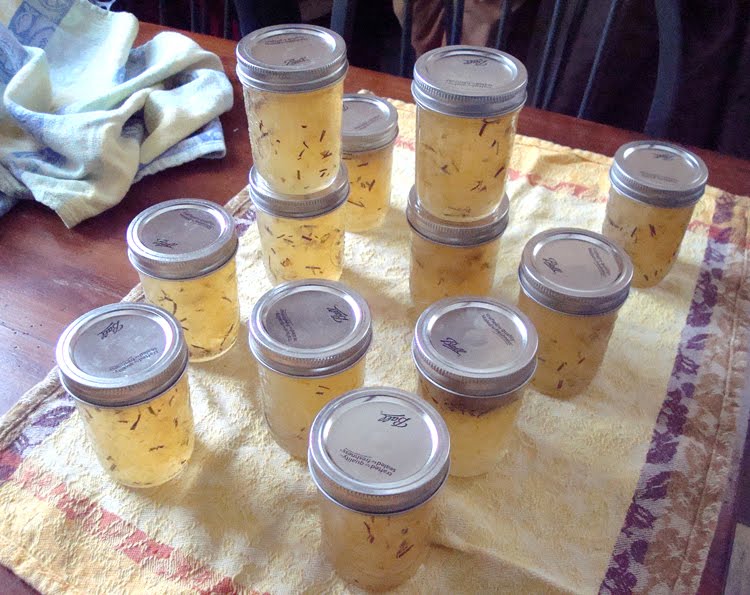
This week i made twenty-two 8 oz. jars of garlic-rosemary jelly . I like to have it with roast chicken, roast pork or lamb, and chops. MMmmmmm....now I have about a 2 year supply! 


updated by @strumelia: 10/25/17 09:31:20AM
Strumelia
@strumelia
11/03/10 11:13:33AM
2,413 posts

The Kitchen Sink - talk about food


OFF TOPIC discussions

Making APPLE SAUCE on Halloween...
If you click on these photos, you will see them much larger. :)
We made apple sauce all day on Halloween this year. We bought a full bushel of Jona Gold apples at a local orchard and set up our kitchen assembly line. Brian peeled and cored the apples on our little hand crank coring machine, and he got each big pot of apples cooking- stirring, adding about 1/2 to one cup of water, and a few dashes of cinammon.
My job was to fill the sterilized pint jars with the finished apple sauce, process the jars in the boiling canning bath for 15 minutes, then give the lids a final tightening and let cool, making sure they sealed properly. I like to hear the little metallic "ping!" of each lid as its vacuum dimple pops in while the jars cool in stacks on the kitchen table. I think of it as little temple bells ringing.
One bushel yielded 38 pints (19 quarts) of really good apple sauce. We figure if we eat an average of one pint per week (and don't give away more than a couple of jars), this will last us into next June, when fresh fruit will again be available locally.

Ken Hulme
@ken-hulme
07/13/10 12:39:38PM
2,157 posts

The Kitchen Sink - talk about food


OFF TOPIC discussions

I actually have put together a Kilted Cook Book over last last week or so. I have it as a .PDF that's going on a CD. A gift to the first of my nieces & nephews to get married. Next week I'm going to Toledo, OH for a few days for the wedding. My niece is getting married to a fella of Scottish ancestry and she requested I wear my kilt!This happens to be the last recipe in the book, for some reason. If you love Chantrelle mushrooms and Brie cheese, this will knock your proverbial socks off.Pizza ProvenalClassic provincial French bread - Fougasse - with traditional toppings, cooked in an Italian manner. I came up with this as an entry in an Isle de France Cheese recipe contest. Didn't win anything significant, but that's OK. I got to eat the experiment, and It Was Good!12 oz. Bread Flour1 packet Rapid Rise YeastA pinch of sugar8 oz. Chantrelle mushrooms, sliced8 oz. Ile de France Brie, sliced with rind in place (I like the rind, take it off if you don't)2-3 tablespoons Olive Oil2 tablespoons Butter, unsalted1-2 tablespoons Herbs de ProvenceDissolve yeast in a few spoonfuls of warm water; add 3 Tbsp flour and a pinch of sugar; mix well to form a soft smooth starter. Form the starter into a ball, cover with cloth and rise in a warm draft-free place for 30 minutes (I use the inside of my microwave).Put the rest of the flour on a work surface and form a well in the center. Add the yeast starter, salt, oil and enough water to make a workable dough. Knead into a ball, place in a bowl, cover and let rise for 30 minutes.Roll the dough into a rectangle to fit a lubed baking sheet. Once the dough is spread out, slash the surface of bread in the traditional herringbone or leaf vein pattern. If you cut all the way through to the pan, it's OK. Sprinkle the dough with the Herbs de Provence. Arrange the cheese and mushroom slices on the surface. Bake in a preheated 450-500F oven 15-20 minutes until GB&D. Rest 10 minutes before serving.

Dusty Turtle
@dusty
07/06/10 01:29:11PM
1,856 posts

The Kitchen Sink - talk about food


OFF TOPIC discussions

I had never thought of sticking whole cloves into a salmon steak before, though I've done that with pork. Years ago I used to make a dill-infused butter specifically for seafood. It's been a while; maybe I should try that again.The Honduran tamales are steamed. They are much larger than Mexican tamales (but not as large as your Oaxacan tamales) and my mother-in-law also puts in what I consider odd ingredients, such as dates, raisins, olives, carrots and potatoes along with the chicken or pork. The last time we made a batch I made a few with crabmeat and corn, which tasted great with a green tomatillo sauce. The corn kernels added a nice contrast to the texture of crabmeat and masa. The hardest part about the tamales is actually wrapping them up in a uniform manner. They seem to taste great with almost anything you put inside.Your two-foot long zacahuile would be quite a sight! I'll have to tell my mother-in-law about those.I'm waiting for the Honduran cookbook to arrive. I'll write up a mini-review when it does. Ken Hulme said:
Awwww, man! I love wild sockeye! Orange sesame oil sounds about right; although I like both sticking a steak with whole cloves before grilling; or dusting with dill as well.

Are Honduran tamales steamed, or baked? Since we have banana leaves everywhere here, I make the Oaxacan style giant baked tamales (6" diameter x 2+ ft long) called zacahuile.
Ken Hulme
@ken-hulme
07/04/10 01:19:12PM
2,157 posts

The Kitchen Sink - talk about food


OFF TOPIC discussions

Awwww, man! I love wild sockeye! Orange sesame oil sounds about right; although I like both sticking a steak with whole cloves before grilling; or dusting with dill as well.Are Honduran tamales steamed, or baked? Since we have banana leaves everywhere here, I make the Oaxacan style giant baked tamales (6" diameter x 2+ ft long) called zacahuile.
Dusty Turtle
@dusty
07/03/10 12:00:10AM
1,856 posts

The Kitchen Sink - talk about food


OFF TOPIC discussions

Thanks, for your efforts, Folkfan.I had indeed spent a lot of time searching the web and never found a Honduran cookbook, though you might have noticed that Ken H did indeed find me one. I like your idea of making one of my own. The fact is that my mother-in-law isn't quite as coherent as she once was, so she can't really follow a recipe. Finding a Honduran cookbook was really just a way to show her that we value her background.I've ordered the bilingual cookbook Ken H found and hopefully we'll have some nice family moments recreating some of those recipes. I think I mentioned elsewhere that around the holidays we all make Honduran tamales together (they are larger than Mexican tamales and wrapped in banana leaves instead of corn husks). Maybe we'll be able to add some other Honduran recipes to that festivity.With my wife's mother from Honduras, her father from Colombia but of Lebanese descent, my mother of Ashkenazi Jewish heritage, and my father of Scots Presbyterian/French Huguenot stock, we can spend all our time trying to honor the various ethnicities, cultures, and religions that represent our ancestry and never really satisfy everyone. Maybe we'll just develop some kind of family gumbo that has a little of everything.

Dusty Turtle
@dusty
07/02/10 10:14:09PM
1,856 posts

The Kitchen Sink - talk about food


OFF TOPIC discussions

Given the continuous pouring of oil into the Gulf, you might want to come this way just to get some fresh seafood.I just bought several pounds of wild sockeye salmon that was caught up north of here. The flesh of the fish is unbelievably dark red. My plan tomorrow is to drizzle some with an orange sesame sauce, wrap it in foil, and grill it. Add some wild rice, a jicama/cucumber salad with fresh dill, and a chilled bottle of white, and we'll enjoy a nice summertime meal! On the 4th, I'll probably grill some to serve with a mango salsa. I'll save you some leftovers, Ken. Ken Hulme said:
If I ever get out to the"other" West Coast, I'll take you up on that!
folkfan
@folkfan
07/02/10 09:35:18PM
357 posts

The Kitchen Sink - talk about food


OFF TOPIC discussions

DT, I didn't find a cookbook exactly, but when I googled Honduran food recipes I came up with several thousand hits. How about browsing some of the different sites which frequently give you the option to do a special Print copy. You could come up with foods from Appetizers to Desserts and copy them off, add family pictures, and make up a notebook cookbook. Your mother in law could be encouraged to write down her own recipes and you could add pictures of her working them up. It would then truly be a family heirloom. Plus you could put all the recipes into those plastic notebook cover sheets and make it a wipe off the splatters cookbook. Dusty Turtle said:
Speaking of cookbooks, has anyone come across a Honduran cookbook? Perhaps even a Central American cookbook?

Several years ago I bought my wife an expensive and beautifully produced cookbook entitled The Taste of Colombia . She was really excited, as was her Colombian father. But her Honduran mother then replied, "Well now you should find her a Honduran cookbook, too." As silly as it seems, she really felt that her side of the family was being ignored.

But I have been unsuccessful at placating my mother-in-law by fulfilling her request. A Honduran cookbook? I am afraid there is no such beast.
Ken Hulme
@ken-hulme
07/02/10 08:40:50PM
2,157 posts

The Kitchen Sink - talk about food


OFF TOPIC discussions

If I ever get out to the"other" West Coast, I'll take you up on that!
Dusty Turtle
@dusty
07/02/10 02:39:41PM
1,856 posts

The Kitchen Sink - talk about food


OFF TOPIC discussions

Wow, Ken, I can't thank you enough. I've searched online and never found that book (or any other Honduran cookbook). That one seems like it is truly an informative resource. I'm about to order a copy.I don't know how to thank you other than cooking you some Honduran food should you ever make it out to northern California.Thanks so much. Ken Hulme said:
Ah, but the beast just lieth in hiding! I discovered that there was the definitive Honduran cookbook written in 1997 and a second edition produced in 2002. It is 312 pages of bi-lingual, Honduran Spanish and English recipes, food history and more.
Ken Hulme
@ken-hulme
07/02/10 02:14:30PM
2,157 posts

The Kitchen Sink - talk about food


OFF TOPIC discussions

Ah, but the beast just lieth in hiding! I discovered that there was the definitive Honduran cookbook written in 1997 and a second edition produced in 2002. It is 312 pages of bi-lingual, Honduran Spanish and English recipes, food history and more. Below is a review written for the release of the Second Edition.There is one spiral bound copy on Amazon right now for $42; the others run from $95 to over $200!!There are undoubtedly other sources from which to obtain the book, but my Spanglish isn't good enough to search them out..."In 1997, Valentina Zaldivar de Farach published the first edition of the book titled: The Honduran Cookbook or El Cocinero Hondureno. The book is a bilingual, historic compilation of valuable information in regards to the way Hondurans cook today as a result of their roots, the influence of the Spanish conquerors and of the various groups of immigrants that came to this land at different times. With this book, Valentina has filled an enormous emptiness within Honduran literature, as she skillfully distinguishes the culinary elements brought by the Indians, the Spanish and the combination of the two, which lead to the birth of Honduran Creole food. She refers to the contribution of Africans from the middle of the 16th century, the Garifuna in the 18th century, and of the Arabian, Italian and Chinese immigrants throughout the Republican life of Honduras, says national historian Mario Martinez Castillo.Indeed, Valentina provides readers with a range of contemporary creole recipes classified according to the one element they are based on: corn, rice and beans, meat, vegetables or tropical fruits. Meanwhile, she added a list of dishes that are specially made on holidays, delicacies from the coast and island regions.Microbiology, dietary values and tipsBut more than offering a collection of delightful recipes, The Honduran Cookbook dedicates several pages to educate the reader on local culinary techniques such as making tortillas that include colorful illustrations that make it easier for you to learn.It is also important to notice that each recipe comes with its respective nutritional values, such as the amount of calories, cholesterol, proteins, fat, fiber and vitamins per serving. In fact, the chapter titled Nutritional Guidelines, presents a large list of food products with their respective nutritional value per 100 grams.But the author goes even further in her research, by introducing the world of food microbiology, as it incorporates updated advances on freezing techniques for popular consumer products and prepared dishes.From corn cream, chilate, and rice with crawfish, to eggplant antipasto, mondongo soup and roasted pork with guaro, this 312 page long book will enrich any daily menu with the most representative, tastier dishes of this country.About the authorValentina Zaldivar de Farach is a Honduran Microbiology professional with wide academic experience as university teacher. Back in the eighties, she directed the Extension Department of the National Autonomous University of Honduras (UNAH), where she performed a remarkable job aimed at rescuing Honduran values, and conceived the project of a literary work aimed at promoting the local culinary culture in a complete way.While living in the United States when her husband Wadi Farach was assigned to the San Francisco Consulate, she was amazed to realize how much this kind of information was sought, but not available.With the advice and help of national and foreign experts in health, nutrition, research and other related matters, she finally was able to print her unique English-Spanish book for the first time in 1997. The 2002 edition presents visual improvements, with the added value of a useful chapter about food conservation.The books cover presents a cutlery set drawn with figures evoking the multicultural influences and natural elements referred to inside. A corn husk, a Mayan face and even the leaning tower of Pisa, Italy are represented in this black and white work of art by Honduran Rafael Caceres, whose other beautiful drawings can be seen throughout the book.This publication intends to serve as an instrument to strengthen the national identity of Honduras, says the author modestly, who invited HTW readers to acquire The Honduran Cookbook at bookstores, and become part of this rich, tasty experience.
Dusty Turtle
@dusty
07/02/10 11:17:41AM
1,856 posts

The Kitchen Sink - talk about food


OFF TOPIC discussions

Speaking of cookbooks, has anyone come across a Honduran cookbook? Perhaps even a Central American cookbook?Several years ago I bought my wife an expensive and beautifully produced cookbook entitled The Taste of Colombia. She was really excited, as was her Colombian father. But her Honduran mother then replied, "Well now you should find her a Honduran cookbook, too." As silly as it seems, she really felt that her side of the family was being ignored.But I have been unsuccessful at placating my mother-in-law by fulfilling her request. A Honduran cookbook? I am afraid there is no such beast.
Dusty Turtle
@dusty
07/02/10 11:04:21AM
1,856 posts

The Kitchen Sink - talk about food


OFF TOPIC discussions

Ken, I agree Lisa has a knack. In particular, her photos of her garden and fresh veggies are just beautiful. Perhaps you could collaborate on something like From the Garden to the Table where each recipe would highlight a particular garden crop, with a photo of the veggie fresh picked and then another photo of a dish fully plated.I watched you on the Food Network competition and was really impressed. I haven't made them yet, but I downloaded the recipes for the Spice Islands Salad and Shrimp & Pork meatballs, which I keep in a file entitled "Uncontrite Modal Recipes." Ken Hulme said:
Thanks DT;

I was actually moderately serious. Lisa takes beautiful food photos, and a collaboration could produce a really great project whether aimed at the dulcimer community or the world at large.

I have written and self-published a couple of cookbooks in the past. Those were without photos although I did have illustrations in one of them. No matter how good the recipes are, what really sells a cookbook today are the photos. But that is also the mega-expensive part of publishing a book - quality color photo reproduction. Self-publishing on-line; where the purchaser gets a .pdf or similar file would be the simplest, least expensive option. Electronic books are becoming all the rage.
Ken Hulme
@ken-hulme
07/02/10 09:30:50AM
2,157 posts

The Kitchen Sink - talk about food


OFF TOPIC discussions

Thanks DT;I was actually moderately serious. Lisa takes beautiful food photos, and a collaboration could produce a really great project whether aimed at the dulcimer community or the world at large.I have written and self-published a couple of cookbooks in the past. Those were without photos although I did have illustrations in one of them. No matter how good the recipes are, what really sells a cookbook today are the photos. But that is also the mega-expensive part of publishing a book - quality color photo reproduction. Self-publishing on-line; where the purchaser gets a .pdf or similar file would be the simplest, least expensive option. Electronic books are becoming all the rage.
Dusty Turtle
@dusty
07/02/10 01:02:58AM
1,856 posts

The Kitchen Sink - talk about food


OFF TOPIC discussions

Ken, I don't know how serious you were being with this comment, but I would strongly urge you to put a cookbook together. You obviously have a lot of recipes for a variety of different foods. You are already spending the time to write them out and describe them. And you have all sorts of tidbits about local history and culture to add to the recipes. And you have a knack not only for how to prepare the food, but how to present it as well. And the best news for marketing purposes is that you already have a small audience of dulcimer players who would buy a copy immediately.In short, the book is half-completed, you obviously enjoy the process, and there are many a hungry dulcimer players out there. Ken Hulme said:
Lisa - you and I need to collaborate on a cookbook. My recipes and your photos. Maybe a dulcimer-focused cookbook. I'm a trained photographer, but you have "the eye" for food photography!!

We could self-publish online with a paid download for the whole illustrated book.
Ken Hulme
@ken-hulme
06/30/10 11:51:35AM
2,157 posts

The Kitchen Sink - talk about food


OFF TOPIC discussions

Ayup! You're the cover girl; not me... I used to have brains, but I took 'em out to wash, and can't remember where I left 'em!Look at the up side - you and Brian would get to cook and eat the dishes as well as photograph them...
  676